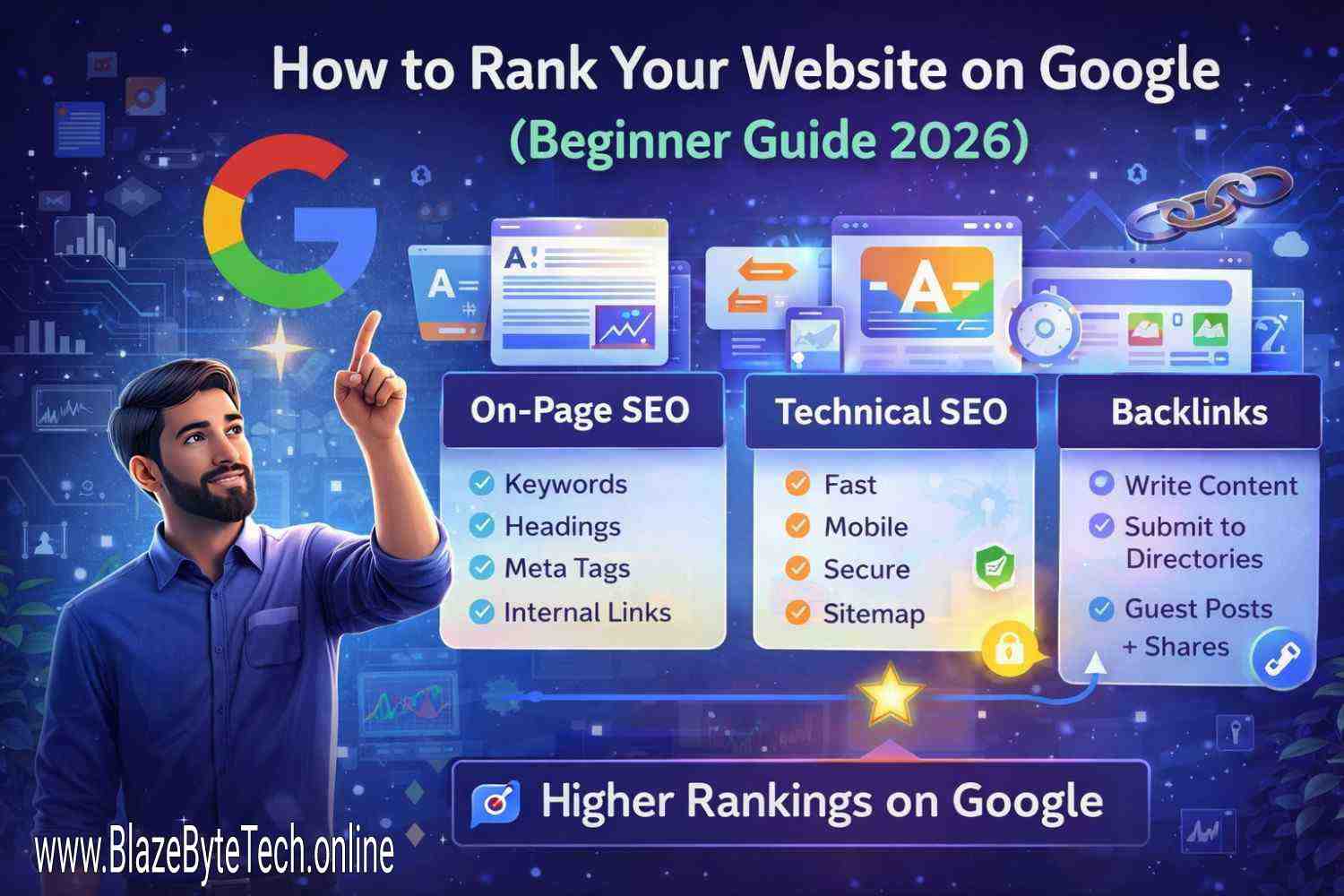
If you have a website but it's not showing on Google, you're missing out on potential customers every day. The good news is — you can fix this with SEO.
SEO (Search Engine Optimization) helps your website rank higher on Google so people can find your business when they search for your services.
1. How Google Ranking Works (Simple Explanation)
Google's job is to show the best and most relevant results to users. It ranks websites based on hundreds of factors, but the most important ones fall into three categories: content quality, website performance, and trust/authority.
Think of Google as a librarian. When someone searches for a term, Google scans its index of billions of pages and tries to find the most useful, accurate, and reliable answer. If your website is optimized properly, it has a much higher chance of appearing on the first page of Google.
The first page of Google gets over 90% of all clicks. Page two and beyond are almost invisible. That's why ranking matters so much — if you're not on page one, you're losing customers to your competitors.
📌 Key takeaway: Google rewards websites that provide the best user experience and most relevant information. SEO is about proving to Google that your site deserves that top spot.
2. On-Page SEO (Optimize Your Website Content)
On-page SEO is about improving the content and structure of your website so Google understands what each page is about. This is the foundation of any SEO strategy because you have full control over it.
🔑 Key On-Page SEO Factors (Explained)
- Use the right keywords — Research what your customers type into Google (e.g., "website developer in Pakistan," "best AC repair Lahore"). Include those keywords naturally in your content, titles, and headings.
- Write clear headings (H1, H2, H3) — Headings help Google understand the structure of your content. Your H1 should be the main title, followed by H2 for main sections, and H3 for sub-sections.
- Optimize meta title and description — The meta title appears as the clickable headline on Google search results. The meta description is the short text below it. Both should include your target keyword and convince users to click.
- Add internal links to other pages — Linking from one page of your website to another helps Google crawl your site and spreads authority. It also keeps visitors on your site longer.
- Use images with proper alt text — Alt text describes your images for Google and visually impaired users. It's another opportunity to include keywords and improve accessibility.
- Write comprehensive, valuable content — Google prefers in-depth content that answers user questions completely. A 300-word page will rarely outrank a 2000-word page that covers everything on the topic.
Good content = better ranking. But "good" means relevant, well-structured, and genuinely helpful to your audience. Don't stuff keywords unnaturally — write for humans first, Google second.
💡 Pro Tip: Use tools like Google Keyword Planner, Ubersuggest, or Ahrefs to find low-competition keywords that your competitors are missing. Target long-tail phrases like "affordable web design for small business in Karachi" — they have less competition and higher conversion rates.
3. Technical SEO (Make Your Website Fast & Smooth)
Technical SEO focuses on how your website performs behind the scenes. Even if your content is excellent, a slow or broken website will not rank well. Google wants to send users to websites that work smoothly.
⚙️ Important Technical SEO Factors
- Fast loading speed — A delay of just one second can reduce conversions by 7%. Use tools like Google PageSpeed Insights to test your site. Compress images, enable caching, and use a fast hosting provider.
- Mobile-friendly design — Over 60% of searches in Pakistan happen on mobile phones. If your website doesn't look good on a small screen, Google will penalize you. Use responsive design.
- Secure website (HTTPS) — Google gives a slight ranking boost to websites with SSL certificates (the padlock icon in the address bar). It also builds trust with your visitors.
- Clean URL structure — URLs should be short, descriptive, and include keywords. For example:
yoursite.com/ac-repair-lahore is better than yoursite.com/p=123.
- Proper sitemap and robots.txt — A sitemap tells Google which pages to index. A robots.txt file tells Google which pages to ignore. Both help Google crawl your site efficiently.
- Fix broken links (404 errors) — Broken links frustrate users and waste Google's crawl budget. Regularly check and fix them.
If your website is slow or broken, Google will not rank it well — no matter how good your content is. Technical SEO is the foundation.
4. Backlinks (Build Trust & Authority)
Backlinks are links from other websites to your site. They act like votes of trust for Google. The more high-quality backlinks you have, the more Google sees your site as an authority in your industry.
Not all backlinks are equal. A single link from a reputable news website or a popular industry blog is worth more than 100 links from low-quality directories. Google evaluates the trustworthiness of the linking site.
🔗 How to Get Quality Backlinks
- Write high-quality blog content — Create articles, guides, or case studies that others naturally want to link to. For example, "10 Common AC Problems and Solutions" could attract links from repair forums.
- Submit your website to reputable directories — Local business directories (like Google My Business, Yellow Pages Pakistan, and local chamber of commerce sites) can provide useful backlinks.
- Guest post on other websites — Write articles for other blogs in your industry in exchange for a link back to your site. Make sure those sites are relevant and have real traffic.
- Share content on social media — While social media links are usually "nofollow" (they don't pass direct SEO value), they can increase visibility and lead to natural backlinks.
- Broken link building — Find broken links on other websites, contact the owner, and suggest your content as a replacement.
- Create infographics or original research — Visual data and unique statistics are highly linkable assets.
The more quality backlinks you have, the higher your website can rank. But avoid buying backlinks or using link farms — Google penalizes unnatural link schemes.
5. Local SEO (Get Found by Nearby Customers)
If you serve customers in a specific city or neighborhood, Local SEO is essential. It helps you rank for searches like "plumber near me" or "bakery in DHA Lahore."
📍 Local SEO Best Practices
- Create and verify your Google My Business (GMB) profile — this is the most important step. Add your address, phone number, business hours, and photos.
- Encourage customers to leave Google reviews. Positive reviews improve your local ranking and build trust.
- Add your city or neighborhood name to key pages (e.g., "AC repair in Gulberg, Lahore").
- Ensure your Name, Address, and Phone number (NAP) are consistent across all directories and your website.
- Get listed in local online directories (e.g., Pakistan Yellow Pages, Locally.pk).
For small businesses like salons, restaurants, or repair services, Local SEO can bring in daily customers without any ad spend.
6. Content Marketing (The Engine of SEO)
Content marketing is the practice of creating valuable content (blogs, videos, guides) to attract and engage your target audience. It works hand-in-hand with SEO.
Google loves fresh, original content. A website that publishes new articles regularly will often outrank a static website. But quantity alone isn't enough — the content must be helpful and well-optimized.
✍️ Content Ideas for Pakistani Businesses
- "How to Choose the Right [Service] in [City]" — e.g., "How to Choose a Web Developer in Lahore"
- "Common Problems with [Product/Service] and Solutions" — builds authority
- Case studies or before/after stories — shows real results
- Listicles: "Top 10 Things to Know Before Buying Property in Islamabad"
- FAQs answering common customer questions — also great for featured snippets on Google
Aim for at least 2-4 blog posts per month. Over time, these pages will accumulate backlinks and rank for many keywords, bringing consistent traffic.
7. Real Example: From Invisible to Page One
Let's say you run a web development agency in Pakistan. You want to rank for "web development services in Pakistan." Here's a step-by-step SEO plan:
- Step 1 — Keyword research: You find that "web development services in Pakistan" gets 500 searches per month, with medium competition. You also target long-tail variations like "affordable web development for startups in Karachi."
- Step 2 — On-page optimization: You create a dedicated service page with that keyword in the H1, meta title, URL, and naturally throughout the content. You add internal links to your portfolio and contact page.
- Step 3 — Technical fixes: You improve your site speed, make it mobile-friendly, and submit a sitemap to Google Search Console.
- Step 4 — Content marketing: You write blog posts like "How to Choose a Web Developer in Pakistan" and "Top 5 Website Mistakes Small Businesses Make." These attract backlinks and social shares.
- Step 5 — Local SEO: You set up Google My Business, get 10+ five-star reviews, and list your agency in local directories.
- Step 6 — Backlink outreach: You guest post on a popular Pakistani tech blog and get a link back to your service page.
After 3-6 months of consistent effort, your website starts appearing on page one for your target keywords. You receive daily inquiries without paying for ads. This is the power of SEO.
The same strategy works for any business — real estate, repair services, clinics, e-commerce stores, and more.
8. Common SEO Mistakes to Avoid
- Keyword stuffing — Repeating the same keyword over and over makes your content unreadable and can get you penalized.
- Ignoring mobile users — If your site is not mobile-friendly, you lose more than half your potential traffic.
- Buying cheap backlinks — This is a quick way to get a Google penalty. Focus on earning links naturally.
- Not using Google Search Console — This free tool tells you exactly how Google sees your site and alerts you to issues.
- Forgetting about user experience — If people click away quickly (high bounce rate), Google assumes your page isn't useful.
- Expecting overnight results — SEO takes 3-6 months to show significant results. Consistency is key.
Avoid these pitfalls, and your SEO journey will be much smoother.
9. Free & Paid SEO Tools
🆓 Google Search Console — Monitor your site's presence in Google search results.
🆓 Google Analytics — Track traffic, user behavior, and conversions.
🆓 Ubersuggest — Keyword ideas and competitor analysis (limited free).
💰 Ahrefs / SEMrush — Advanced backlink and keyword research (paid).
🆓 PageSpeed Insights — Test your website speed.
🆓 Yoast SEO (WordPress) — Helps optimize on-page SEO easily.
10. Consistency is the Key
SEO is not a one-time task. It requires ongoing effort — updating old content, building new backlinks, monitoring your rankings, and staying up to date with Google's algorithm changes.
But the reward is worth it. Once your website ranks, it can bring long-term, free traffic for months or even years. Unlike paid ads that stop the moment you stop paying, SEO compounds over time.
📅 SEO Timeline Expectation:
Month 1-2: Setup, technical fixes, and content creation.
Month 3-4: Initial ranking improvements, small traffic increase.
Month 5-6: Significant growth, leads start coming.
Month 6+: Consistent traffic and ROI.
Final Thoughts
Ranking on Google is possible for any business if you follow the right strategy. Focus on on-page SEO, technical SEO, backlinks, and local SEO to improve your visibility. Be patient, be consistent, and measure your results.
The internet is crowded, but with proper SEO, your business can stand out and attract customers who are actively searching for what you offer. Don't let your website stay invisible.
At BlazeByte Tech, we help businesses rank on Google and generate real leads through SEO. Contact us today to grow your business online.